

Understanding the Approach
E‑pedagogy refers to the ways in which teaching and learning are designed and enacted in digital, online, and blended environments. It builds on established learning theories—such as constructivism, cognitivism, and behaviourism—while also drawing on more contemporary perspectives, including connectivism, to respond to the opportunities and challenges of technology‑enhanced learning.
Together, these theories provide a foundation for developing effective approaches to online and blended learning. Based on this theoretical grounding, a number of pedagogical models have been developed to support TEL practice.
On this page, we explore three commonly referenced models: Mayes and Fowler’s (1999) Conceptualisation Cycle, Laurillard’s (2002) Conversational Framework, and Salmon’s (2011) Five Stage Model.
Teaching Scenarios & Relevance
Describe the teaching situations where this approach is particularly useful.
You might include:
Common teaching challenges it supports (e.g. engagement, feedback, flexibility)
Types of modules, class sizes, or teaching modes where it works well
Situations where it may need adapting or careful consideration
Designing for this Approach
Outline the key design considerations staff should think about when using this approach.
For example:
Alignment with learning outcomes
Student workload and expectations
Inclusivity, accessibility, and participation
Structure, timing, or scaffolding needed for success
Frameworks & Guiding Principles
Here are some different frameworks to help you understand.
Mayes’ Conceptualisation Cycle
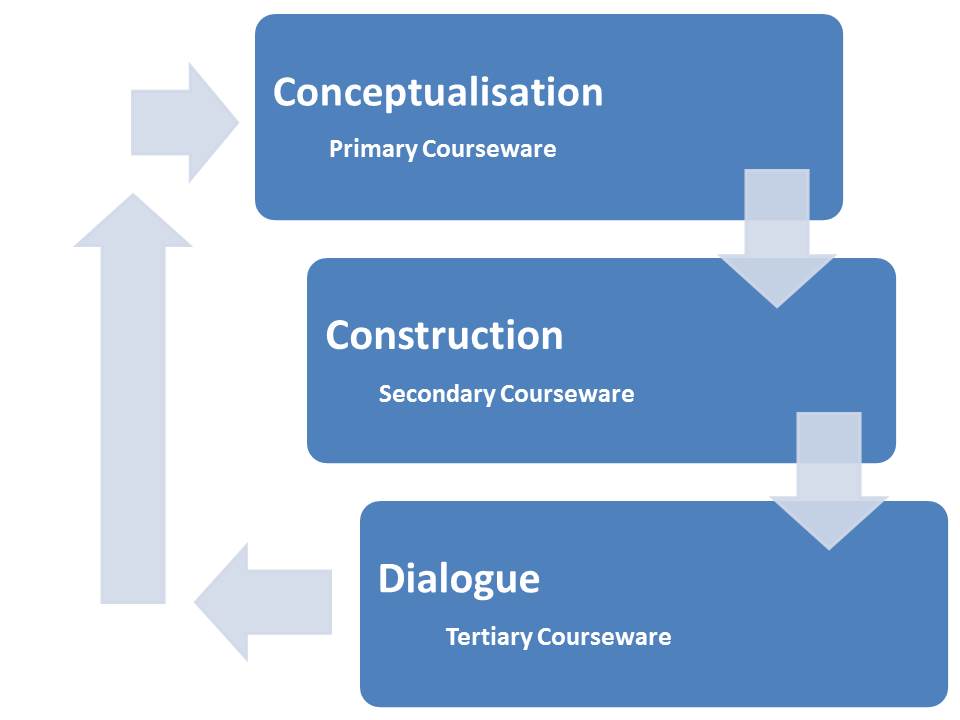
At the conceptualisation stage, students are exposed to other people’s ideas or concepts. The purpose of this stage is to provide the learner with an awareness of what they need to learn and understand, this is most commonly achieved in face to face classroom or lecture based sessions but also takes place in the VLE. Primary Courseware is used to support, for example, online lecture notes, instructional videos, reading lists etc., which are a good way of giving students information.
At the construction stage tutors provide learners with meaningful online tasks that allow them to apply the concepts outlined to them in the conceptualisation stage, such as lab work, preparing presentations, writing blog posts, online quizzes, etc. The learning environment, tasks and task materials are referred to as Secondary Courseware.
However, it is only at the dialogue stage, in the performance of tasks in which these new concepts are tested during conversation with tutors and peers, that learning takes place. This is achieved by students participating in effective computer mediated communication (CMC) with their tutors and fellow students whereby their understanding and conceptualisations outlined in stage 1 and applied in stage 2 can be assessed in applied contexts via online discourse which will bring to light any misconceptions about the subject and allow these to be addressed via meaningful online two way conversations. This is engagement with Tertiary Courseware e.g. discussion forums, videoconferencing, simulations etc.
However, it is only at the dialogue stage, in the performance of tasks in which these new concepts are tested during conversation with tutors and peers, that learning takes place. This is achieved by students participating in effective computer mediated communication (CMC) with their tutors and fellow students whereby their understanding and conceptualisations outlined in stage 1 and applied in stage 2 can be assessed in applied contexts via online discourse which will bring to light any misconceptions about the subject and allow these to be addressed via meaningful online two way conversations. This is engagement with Tertiary Courseware e.g. discussion forums, videoconferencing, simulations etc.
Laurillard’s Conversational Framework
Laurillard’s Conversational Framework (Laurillard, 2002) has been widely cited and used as both a design template and an analytic tool. Laurillard describes the stages involved in the dialogic interaction between a tutor and student, demonstrating the way in which concepts are internalised and adapted by each in the process. Laurillard stresses that, for higher level learning, dialogue must take place at both a theoretical and practical level.
Laurillard (2002) claims that there are four main aspects of the teaching-learning process and that different educational media can be analysed (and used) in terms of these dimensions:
- Tutors’ Concepts
- Tutors’ Constructed Learning Environment
- Students’ Concepts
- Students’ Specific Actions
Tutors and learners’ conception should be mutually accessible Both should agree on learning objectives
Tutor must adapt objectives with regards to existing conceptions Learners must integrate feedback and link it to his own conception
Tutor must create an environment adapted to the learning task given to the learner Tutor must focus on support for task and give appropriate feedback to the learner
Tutor should support the learner to revise his conceptions and to adapt the task to learning needs Learners should reflect with all stages of the learning process (initial concepts, tasks, objectives, feedback, …)
Salmon’s Five Stage Model
Professor Gilly Salmon first developed the practical Five Stage Model, ‘scaffolding’ a progressive learning environment through online activities, or ‘e-tivities’, as part of her own research into online learning and the use of computer-mediated communication (CMC), and published it in her book E-moderating (Salmon, 2011). The five stages are:
At stage one, e-moderators need to provide support and allow sufficient time to enable learners to access their course materials. Maintaining motivation in the early stages is important because you do not want to deter your learners before they have properly started the course. At this early stage, there will be little interaction between learners.
Now that your learners have all successfully ‘arrived’, stage-two focuses upon encouraging your learners to get to know each other; even if you are teaching students online as part of a blended learning approach, and everyone has already met each other in the lecture theatre or seminar room, it is still important to go through this process in the online environment too.
On the successful completion of stage-two, your learners can be encouraged to share information as they continue to connect and build upon the relationships they started to develop with each other earlier. Exchanging information can be fun and beneficial but it can also be overwhelming if too much is shared and learners cannot identify what is useful to them.
At stage-four, learners should now be ready for more active online learning and can begin to construct new knowledge as a result of their interaction with one another, drawing upon each other’s skills and experience.
At stage-five, learners become more independent from the e-moderator and take more responsibility for their own learning and their group. Learner interaction with peers is not necessarily as frequent and demanding as seen in stages two to four, as learners can become more focused upon their individual learning goals again.
SAMR Model
SAMR is a model designed to help educators infuse technology into teaching and learning. SAMR is an acronym that stands for Substitution, Augmentation, Modification, and Redefinition, and the model supports and enables academics to design, develop, and infuse digital learning experiences that utilise technology.
At this stage, technology is directly substituted for a more traditional one, a simple direct replacement.
The technology is again directly substituted for a traditional one, but with significant enhancements to the student experience. In other words, you ask yourself if the technology increases or augments a student’s productivity and potential in some way.
In this stage, you are beginning to move from enhancement to transformation on the model. Instead of replacement or enhancement, this is an actual change to the design of the session and its learning outcome. The key question here is ‘does the technology significantly alter the task’?
The last stage of the SAMR model is Redefinition and represents the pinnacle of how technology can transform a student’s experience. In this case, you ask yourself if the technology tools allow educators to redefine a traditional task in a way that would not be possible without the tech, creating a novel experience.
TEL Support
Explain how technology‑enhanced learning can support or enhance this approach.
Consider:
What TEL makes easier, more flexible, or more effective
Examples of digital approaches that work well
How TEL supports learning without adding unnecessary complexity
Case Studies:
There are no Case studies found at the moment. Sorry :(.
Next Steps:
Describe a real example from practice where this approach has been used.
You might include:
The teaching context or challenge
What approach was taken
How TEL supported the design
What was learned or what others could take from this example